
Podcast: Play in new window | Download
Advisors on This Week’s Show
(with Jason Scuglik)
Week in Review (April 6-10, 2026)
Significant Economic Indicators & Reports
Monday
No major announcements
Tuesday
The Commerce Department signaled ongoing weakness in demand for long-lasting manufactured products as orders for durable goods declined in February for the third month in a row and the fourth time in five months. A drop-off in requests for aircraft led a 1.4% dip in orders for the month, though commercial aircraft orders boosted the year-to-year totals to an 8.1% increase. Excluding transportation equipment, orders rose 0.8% from January and were up 5.3% from February 2025. Core capital goods orders, considered a proxy for business investments, rose 0.6% for the month and increased 4.2% from the same time last year.
The Federal Reserve reported that revolving credit debt outstanding rose at an annual rate of 0.6% in February. That was down from paces of 2.3% and 7.4% in the preceding months and suggests a rising reluctance among consumers to carry credit card debt. Revolving credit debt has declined 1.8% from its peak in October 2024. The report showed total consumer debt growing at an annual 2.2% pace, including a 2.8% rise in non-revolving credit, which includes student loans and vehicle financing.
Wednesday
No major announcements
Thursday
The four-week moving average for initial unemployment claims rose for the first time in six weeks but remained 42% below the long-term average. The measure is an ongoing indicator of employers’ reluctance to let go of workers. The Labor Department also reported that a little more than 2 million Americans claimed jobless benefits in the most recent week. That’s down 1.3% from the week before and down 2.3% from the same time last year.
U.S. economic growth slowed more than previously reported at the end of 2025. The Bureau of Economic Analysts said gross domestic product rose at an annual pace of 0.5% in the fourth quarter, down from an earlier estimate of 0.7% and a pace of 4.4% in the third quarter. The bureau said lower investment accounted for most of the revision, although consumer spending also slowed, and government spending declined sharply — partly tied to the shutdown in October and November.
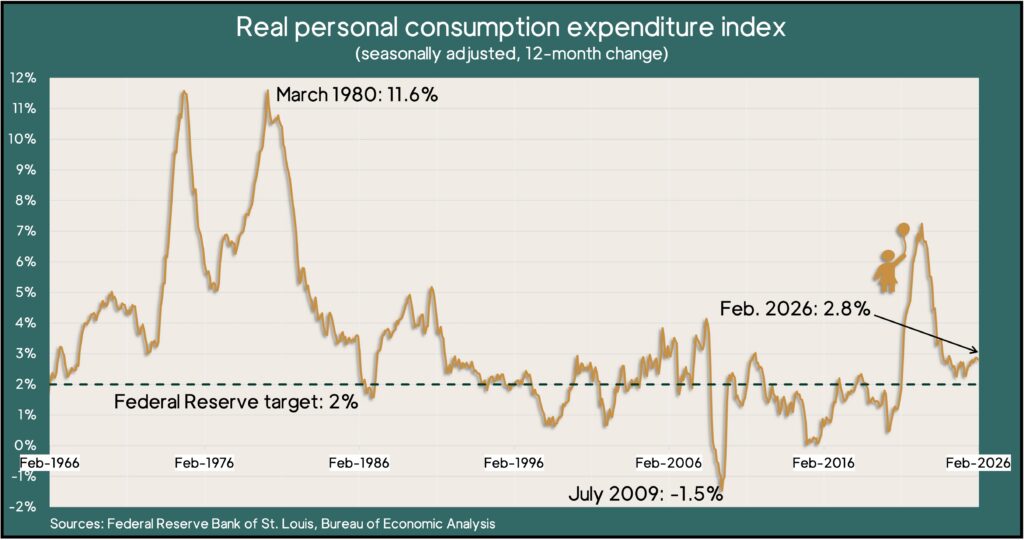
The Bureau of Economic Analysis separately reported that consumer spending rose 0.5% in February. Meanwhile, personal income fell 0.1%, resulting in a drop in the personal savings rate. The same report showed the Federal Reserve Board’s favorite inflation gauge unchanged from January at 2.8%. The Fed’s long-term target for inflation broadly is 2%.
Friday
Higher energy prices led a surge in inflation in March. The Bureau of Labor Statistics reported that the Consumer Price Index, the broadest measure of inflation, rose 0.9% from February and 3.3% from the year before — the biggest one-year increase since May 2024. Energy costs increased 12.5% in the last year, including a 21.2% spike in gasoline prices just in March. Core inflation, excluding food and energy products, rose 0.3% from February and 2.6% from the year before.
The war in Iran has taken a toll on Americans’ confidence in the economy and their financial outlooks. University of Michigan said its consumer sentiment index dropped 11% in March and was 9% below where it stood a year ago. The university said sentiment fell broadly across demographic groups. Expectations for inflation reached the highest levels since a year ago, when they shot up amid uncertainty over U.S. tariff policies.
Market Closings for the Week
- Nasdaq – 22903, up 1024 points or 4.7%
- S&P 500 – 6817, up 234 points or 3.6%
- Dow Jones Industrial Average – 47917, up 1412 points or 3.0%
- 10-year U.S. Treasury Note – 4.32%, up 0.01 point