

Podcast: Play in new window | Download
Advisors on This Week’s Show
(with Max Hoelzl, Joel Dresang, engineered by Jason Scuglik)
Week in Review (March 9-13, 2026)
Significant Economic Indicators & Reports
Monday
No major announcements
Tuesday
The National Association of Realtors said the pace of existing home sales rose 1.7% in February, though it was still behind the year-ago rate and around the lowest in more than 30 years. The trade group called demand “muted” as lower mortgage rates and rising wages combined to make housing more affordable than it has been since March 2022. The median sales price rose to $398,000, up 0.3% from February 2025, the 32nd consecutive increase.
Wednesday
The broadest measure of inflation stayed steady in February. The Bureau of Labor Statistics reported the Consumer Price Index rose 2.4% from February 2025, unadjusted for seasonality. That was the same rate as January and still above the Federal Reserve’s long-term target of 2%. Shelter costs led the monthly uptick. Gas prices rose for the first time in three months — prior to subsequent spikes spurred by the Iran war. The core CPI, excluding volatile food and energy costs, was up 2.5% from the year before, also the same rate as January.
Thursday
The U.S. trade deficit narrowed by 25% in January to $54.5 billion. The Bureau of Economic Analysis said exports rose 5.5% from December, led by non-monetary gold and other precious metals, as well as computers and civilian aircraft. Imports shrank 0.7%, led by pharmaceuticals and automobiles. Since January 2025, the trade gap contracted by almost 58% as exports expanded 10% and imports fell 11%.
The four-week moving average for initial unemployment claims fell for the third time in four weeks, suggesting employers continue to be reluctant to let workers leave. According to data from the Labor Department, the four-week number was 41% below the 59-year average. More than 2.2 million individuals were receiving jobless benefits in the latest week, up 3.5% from the week before and down less than 1% from the year before.
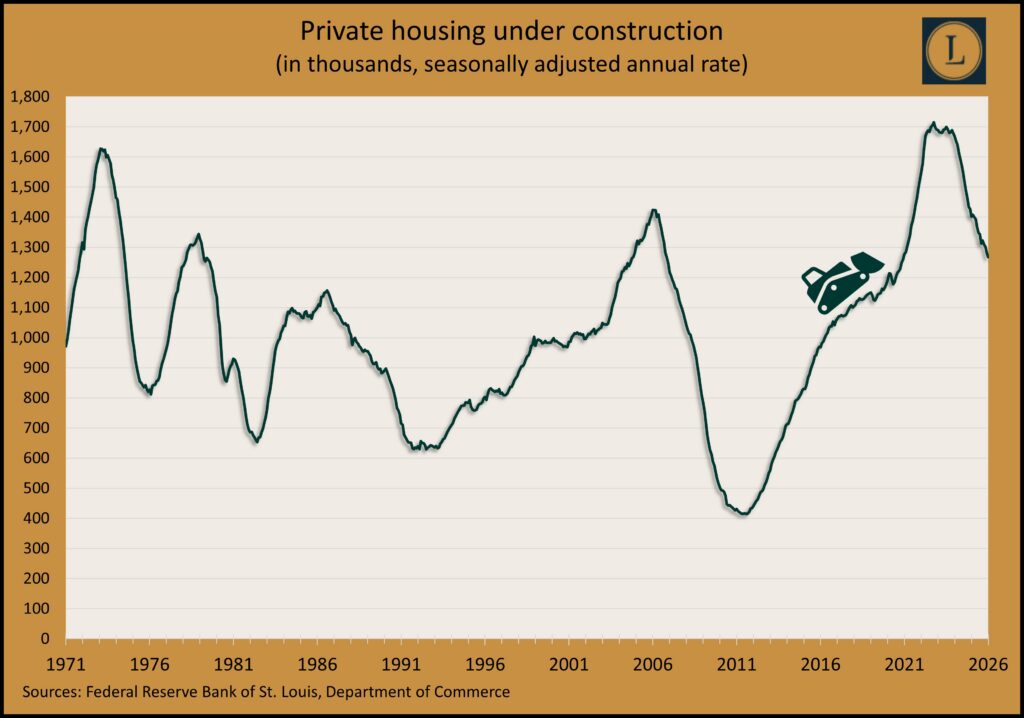
The Commerce Department said housing starts and building permits in January continued to track below their pre-COVID levels. Although the annual pace of housing starts rose 7% from December and 9.5% from January 2025, it has been below the pre-pandemic level for nearly two years. Building permits fell both from the month before and the year before. Meanwhile, the pace of houses under construction fell again, sinking 26% below their record pace in late 2022.
Friday
The U.S. economy grew slower than previously estimated at the end of 2025. The gross domestic product rose at an annual rate of 1.7% in the fourth quarter, down from a preliminary report of 2.4% and below the 4.4% pace in the third quarter. The Bureau of Economic Analysis blamed the downward revision on weaker consumer spending and private investments and greater declines in government spending and exports. Adjusted for Inflation, GDP grew 2.1% in 2025, the weakest since a 2.1% decline in 2020.
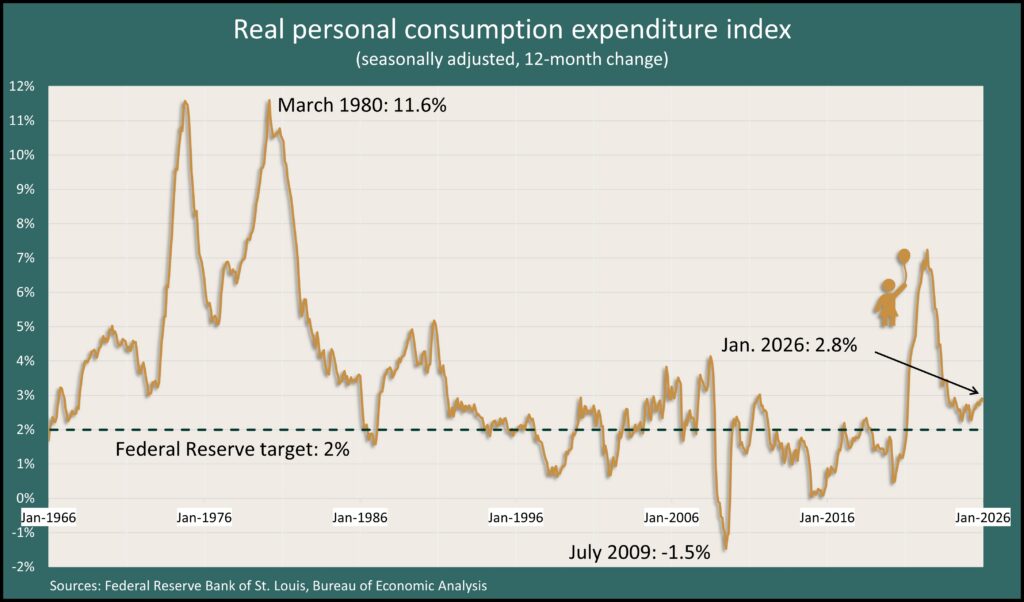
In a possible sign of consumer restraint, personal spending fell slightly behind the pace of personal income in January, raising the personal savings rate to its highest level in six months. The Bureau of Economic Analysis reported a savings rate of 4.5% of disposable income, which has been below the pre-pandemic level of 7.5% for more than four years. The same report showed the Federal Reserve’s preferred measure of inflation staying above its long-range target of 2%. The personal consumption expenditure index was up 2.8% from the year before, vs. 2.9% in December. The last time it was below 2% was February 2021.
Durable goods orders were unchanged in January as a plunge in demand for commercial aircraft offset scattered gains elsewhere. The Commerce Department reported that orders overall ran 9% higher than the year before. Excluding volatile transportation orders, demand rose 0.4% from the month before and was up 4.4% from January 2025. Core capital goods orders, a proxy for business investments, were unchanged for the month and up 2.9% from the year before.
U.S. employers posted 6.9 million job openings in January, up marginally from December but below the pre-COVID level for the third month in a row. Postings were down 43% from their peak nearly five years ago, the Bureau of Labor Statistics reported. Based on openings and unemployed job seekers, the supply of available labor has outpaced demand since July. That’s after more than four years of the balance favoring workers. The number and rate of workers voluntarily quitting – an indication of worker confidence – stayed below pre-pandemic levels for the 25th month in a row.
The University of Michigan said consumer sentiment reversed course following the onset of war in Iran. Polling done before Feb. 28 showed improvements in consumer outlooks, the university said, but opinions plunged thereafter regardless of respondents’ incomes, ages or political affiliations. Overall, consumers had lower expectations for their personal finances and higher forecasts for inflation.
Market Closings for the Week
- Nasdaq – 22105, down 282 points or 1.3%
- S&P 500 – 6632, down 108 points or 1.6%
- Dow Jones Industrial Average – 46560, down 942 points or 2.0%
- 10-year U.S. Treasury Note – 4.29%, up 0.15 point